
Software Development Lifecycle for AI/ML Applications
- Software Development Lifecycle for AI/ML Applications
- Introduction
- Overview
- Agile Process
- Lifecycle Phases
- Quality Assurance
- Documentation
- Compliance and Security
- Appendices
Introduction
Purpose
The purpose of this Software Development Lifecycle (SDLC) document is to provide a comprehensive framework for the development, deployment, and maintenance of AI/ML applications within the Children's National Hospital. This document aims to ensure that all AI/ML projects are executed efficiently, effectively, and in compliance with healthcare regulations and standards. By following the guidelines outlined in this document, the development team can deliver high-quality, reliable, and secure AI/ML solutions that enhance patient care, streamline hospital operations, and support clinical decision-making.
Scope
This Software Development Lifecycle (SDLC) document applies to all AI/ML development projects undertaken by Children's National Hospital AI/ML development team withing the Enterprise Data and AI organization. It encompasses the entire lifecycle of AI/ML applications, from initial planning and requirements gathering through design, development, testing, deployment, and maintenance. The document outlines the processes, methodologies, and best practices to be followed to ensure the successful delivery of AI/ML solutions that meet the hospital's needs and comply with relevant healthcare regulations and standards.
The scope includes:
- Defining roles and responsibilities of team members and stakeholders.
- Establishing a standardized approach to project planning and execution using Agile methodologies.
- Ensuring rigorous testing and validation of AI/ML models to maintain high standards of accuracy and reliability.
- Implementing robust security measures to protect patient data and ensure compliance with healthcare regulations.
- Providing guidelines for continuous monitoring, maintenance, and improvement of AI/ML applications.
This document is intended to serve as a reference for all team members involved in AI/ML projects, ensuring consistency and quality across all development efforts.
Definitions, Acronyms, Abbreviations
| Acronym/Abbreviation | Definition |
|---|---|
| SDLC | Software Development Life Cycle |
| The Hospital | Children's National Hospital |
| AI | Artificial Intelligence |
| ML | Machine Learning |
| FDA | Food and Drug Administration |
Overview
Project Description
This document outlines the SDLC for AI/ML projects undertaken by The Hospital's AI/ML development team. These projects aim to leverage artificial intelligence and machine learning technologies to enhance various aspects of hospital operations, patient care, and clinical decision-making. The AI/ML solutions developed will address a wide range of applications, including but not limited to:
- Predictive analytics for patient outcomes and hospital resource management.
- Automated image and signal analysis for diagnostic support.
- Natural language processing for clinical documentation and patient communication.
- Personalized treatment recommendations based on patient data and medical history.
- Optimization of hospital workflows and administrative processes.
Each project will follow a standardized approach as outlined in this SDLC document, ensuring consistency, quality, and compliance with healthcare regulations. The development team will employ Agile methodologies to facilitate iterative development, continuous feedback, and rapid adaptation to changing requirements. By adhering to these guidelines, the team will deliver robust, reliable, and secure AI/ML solutions that meet the hospital's strategic goals and improve overall healthcare delivery.
Objectives
The primary objectives of AI/ML projects undertaken by the hospital's AI/ML development team are to:
- Enhance Patient Care: Develop AI/ML solutions that improve patient outcomes by providing accurate, timely, and personalized medical insights and recommendations.
- Support Clinical Decision-Making: Create tools that assist healthcare professionals in making informed decisions through predictive analytics, diagnostic support, and treatment optimization.
- Optimize Hospital Operations: Implement AI/ML technologies to streamline hospital workflows, improve resource management, and reduce operational inefficiencies.
- Ensure Data Security and Compliance: Adhere to stringent data security protocols and comply with healthcare regulations to protect patient information and maintain trust.
- Foster Innovation: Encourage continuous innovation and improvement in AI/ML methodologies to stay at the forefront of healthcare technology advancements.
- Promote Interdisciplinary Collaboration: Facilitate collaboration between AI/ML experts, healthcare professionals, and other stakeholders to ensure the development of practical and effective solutions.
- Provide Training and Support: Offer comprehensive training and support to end-users to ensure the effective adoption and utilization of AI/ML applications.
By achieving these objectives, the AI/ML development team aims to deliver high-quality, reliable, and secure AI/ML solutions that contribute to the hospital's mission of providing exceptional patient care and advancing medical research.
Agile Process
The Agile process is guided by a set of core principles that emphasize flexibility, collaboration, and customer satisfaction. These principles are designed to enhance the development process and ensure the delivery of high-quality AI/ML solutions.
Agile Principles
- Customer Satisfaction: Prioritize customer satisfaction through early and continuous delivery of valuable software.
- Welcome Change: Embrace changing requirements, even late in development, to provide a competitive advantage.
- Frequent Delivery: Deliver working software frequently, with a preference for shorter timescales.
- Collaboration: Foster close, ideally daily, collaboration between business stakeholders and developers.
- Motivated Individuals: Build projects around motivated individuals, providing them with the environment and support they need, and trust them to get the job done.
- Face-to-Face Communication: Use face-to-face communication as the most efficient and effective method of conveying information within a development team.
- Working Software: Measure progress primarily through the delivery of working software.
- Sustainable Development: Promote sustainable development practices, maintaining a constant pace indefinitely.
- Technical Excellence: Focus on continuous attention to technical excellence and good design to enhance agility.
- Simplicity: Maximize the amount of work not done by focusing on simplicity.
- Self-Organizing Teams: Encourage self-organizing teams to produce the best architectures, requirements, and designs.
- Reflection and Adjustment: Regularly reflect on how to become more effective and adjust behavior accordingly.
Agile Framework
The AI/ML development team will follow the Scrum framework, a popular Agile methodology that emphasizes iterative development, collaboration, and flexibility. The key components of the Scrum framework include:
- Roles
- Product Owner: Responsible for defining the project vision, managing the product backlog, and ensuring the team delivers value to stakeholders.
- Scrum Master: Facilitates the Scrum process, removes impediments, and ensures the team adheres to Agile principles and practices.
- Development Team: A cross-functional group of professionals who design, develop, test, and deliver the AI/ML application.
- Artifacts
- Product Backlog: A prioritized list of features, enhancements, and bug fixes that the team will work on. The Product Owner manages and refines the backlog.
- Sprint Backlog: A subset of the product backlog items selected for implementation during a sprint. The development team commits to completing these items within the sprint.
- Increment: The sum of all completed product backlog items at the end of a sprint, representing a potentially shippable product.
- Events
- Sprint Planning: A meeting at the beginning of each sprint where the team selects items from the product backlog to work on and creates a plan for delivering them.
- Backlog Grooming: A regularly occurring meeting to flesh out details of backlog items, including a description, well defined acceptance criteria, and a story point value.
- Daily Scrum: A short, daily meeting where the team discusses progress, plans for the day, and identifies any impediments.
- Sprint Review: A meeting at the end of each sprint where the team demonstrates the completed work to stakeholders and gathers feedback.
- Sprint Retrospective: A meeting at the end of each sprint where the team reflects on the sprint and identifies areas for improvement.
- Sprints
- Sprint Duration: Sprints are time-boxed iterations, typically lasting 2-4 weeks, during which the team works on the selected sprint backlog items.
- Sprint Goals: Each sprint has specific goals that align with the overall project objectives and deliver incremental value to stakeholders.
Lifecycle Phases
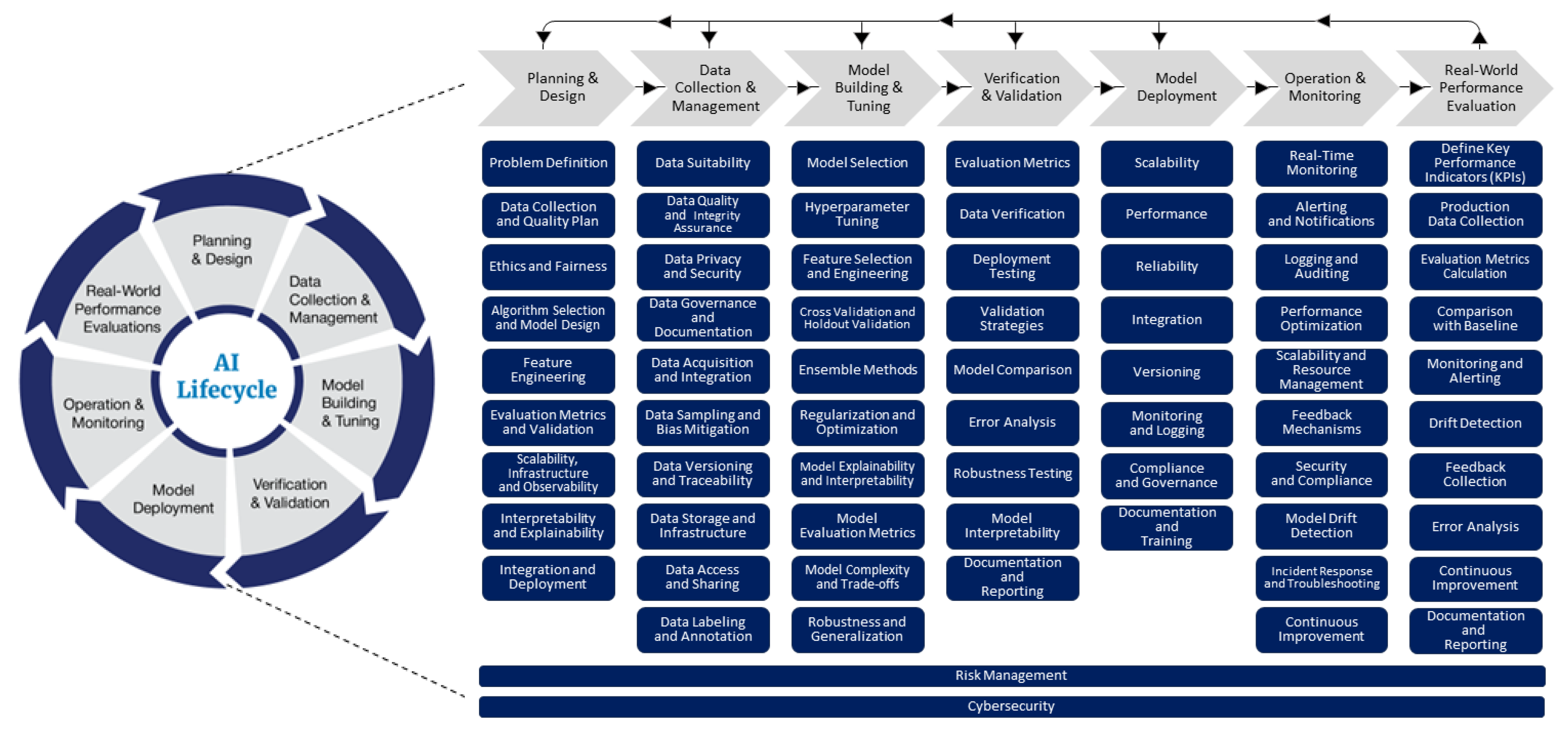
The AI Lifecycle as described by the Food and Drug Administration (FDA)
The AI/ML development lifecycle is divided into several phases, each with specific activities and deliverables. These phases ensure a structured approach to developing, deploying, and maintaining AI/ML solutions. In addition to the activities in the above image, we clarify and contribute the following additional components per phase:
- Planning and Design
- Requirements Gathering: Collaborate with stakeholders to collect and document project requirements, including system accuracy/performance requirements. Use techniques such as interviews, surveys, and workshops.
- Feasibility Study: Assess the technical, operational, and financial feasibility of the project. Identify potential risks and mitigation strategies.
- Sprint Planning: Conduct sprint planning meetings to select items from the product backlog and create a plan for the upcoming sprint.
- System Analysis: Analyze the current system and identify areas for improvement. Define the system architecture and data flow.
- Risk Analysis: Identify potential risks, including data privacy, security, and ethical considerations. Develop mitigation strategies to address these risks.
- Data Collection and Management
- Data Plan: Create a clear data plan to ensure necessary data is collected from various sources and integrated appropriately.
- Model Building and Tuning
- System Design: Create high-level and detailed design documents, including system architecture, data models, and user interfaces.
- Data Design: Design the data architecture, including databases, data pipelines, and data storage solutions. Ensure data quality and integrity.
- AI/ML Model Development: Develop and train the AI/ML model (if needed) following best practices (e.g., hyperparameter tuning, train/test validation, appropriate evaluation criteria, bias and fairness assessment, etc.).
- Verification and Validation
- Integration: Integrate different components of the system, including AI/ML models, databases, and user interfaces. Ensure seamless interaction between components.
- Test Plan: Develop a comprehensive test plan that includes unit testing, integration testing, system testing, and user acceptance testing (UAT).
- Unit Testing: Conduct unit testing to verify the functionality of individual components. Use automated testing tools where possible.
- System Testing: Perform system testing to ensure the entire system works as expected. Identify and fix any issues.
- User Acceptance Testing (UAT): Conduct UAT with end-users to validate the system against requirements. Gather feedback and make necessary adjustments.
- Model Deployment
- Deployment Plan: Create a detailed deployment plan that includes deployment steps, rollback procedures, and contingency plans.
- AI/ML System Component Development: Develop additional components required for the broader system (e.g. APIs, user interfaces, system integrations, etc.).
- Training: Provide training sessions and materials for end-users to ensure they can effectively use the AI/ML solutions.
- Operation and Monitoring
- Maintenance Plan: Outline the maintenance process, including regular updates, bug fixes, and performance monitoring.
- Support: Establish support procedures and contact information for users to report issues and request assistance.
- Real-World Performance Evaluation
- Provider Involvement: Ensure the proper healthcare providers are engaged to deliver more meaningful results.
These are covered in more detail in the FDA AI Lifecycle Description
Quality Assurance
Quality assurance (QA) is a critical aspect of the AI/ML development lifecycle, ensuring that the solutions delivered are of high quality, reliable, and meet the specified requirements. The QA process involves defining quality metrics, conducting reviews, and implementing testing procedures to identify and address issues early in the development process. The key components of the QA process include:
- Quality Metrics
- Model Metrics: Measures of the AI/ML model's performance on the task it was trained to perform (e.g. predicting an outcome, answering a question factually).
- System Performance: Assess the non-functional performance of the system, including response times and resource utilization.
- Usability: Ensure the system is user-friendly and meets the needs of end-users.
- Security: Verify that the system adheres to security standards and protects patient data.
- Review Process
- Code Reviews: Conduct regular code reviews to ensure adherence to coding standards and best practices. Peer reviews help identify potential issues early.
- Design Reviews: Review design documents to ensure they meet the project requirements and are aligned with the overall system architecture.
- Test Plan Reviews: Review test plans to ensure comprehensive coverage of all functionalities and potential edge cases.
- Testing Procedures
- Unit Testing: Perform unit testing to verify the functionality of individual components. Use automated testing tools to streamline the process.
- Integration Testing: Conduct integration testing to ensure that different components of the system work together seamlessly.
- System Testing: Perform system testing to validate the entire system's functionality, performance, and security.
- User Acceptance Testing (UAT): Conduct UAT with end-users to ensure the system meets their needs and expectations. Gather feedback and make necessary adjustments.
- Regression Testing: Perform regression testing to ensure that new changes do not negatively impact existing functionalities.
- Continuous Improvement
- Feedback Loop: Where feasible, establish a feedback loop with end-users and stakeholders to gather insights and identify areas for improvement.
- Post-Implementation Reviews: Conduct post-implementation reviews to assess the success of the project and identify lessons learned for future projects.
- Continuous Monitoring: Implement continuous monitoring of AI/ML models to ensure they maintain their accuracy and performance over time. Update models as needed based on new data and feedback.
Documentation
Effective documentation is essential for the successful development, deployment, and maintenance of AI/ML solutions. It ensures that all stakeholders have a clear understanding of the project and provides a reference for future development and support. The key components of the documentation process include:
- Technical Documentation
- Enterprise Architecture Review Board Submission: Document meant to help consider all information resources that will be used as part of the project.
- Coding Standards: Set of standard coding practices, per language, followed by all team members.
- System Architecture Document: Describe the overall system architecture, including components, data flow, and interactions.
- Model Training Documents: Documentation for how the AI/ML system was trained and evaluated, ideally using both historical/retrospective data as well as a prospective (i.e., 'shadow deployment') evaluation.
- API Documentation: Document the application programming interfaces (APIs) used in the system, including endpoints, request/response formats, and usage examples.
- Code Documentation: Include inline comments and external documentation to explain the codebase, making it easier for developers to understand and maintain.
- Deployment Guides: Provide step-by-step instructions for deploying the AI/ML solutions, including configuration settings and dependencies.
- User Documentation
- User Manuals: Create comprehensive user manuals that explain how to use the AI/ML solutions, including features, functionalities, and troubleshooting tips.
- Quick Start Guides: Develop quick start guides for new users, providing an overview of the system and basic usage instructions.
- Training Materials: Prepare training materials, such as presentations, videos, and tutorials, to help users understand and effectively use the AI/ML solutions.
- Project Documentation
- Project Plan: Document the project plan, including timelines, milestones, and deliverables.
- Meeting Minutes: Record minutes of project meetings to capture decisions, action items, and discussions.
- Status Reports: Provide regular status reports to stakeholders, detailing progress, issues, and next steps.
- Compliance Documentation
- Regulatory Compliance: Document how the AI/ML solutions comply with relevant healthcare regulations and standards.
- Security Policies: Outline the security policies and measures implemented to protect patient data and ensure compliance with data protection regulations.
- Maintenance Documentation
- Maintenance Plan: Document the maintenance plan, including procedures for updates, bug fixes, and performance monitoring.
- Support Procedures: Provide documentation on support procedures, including contact information and escalation paths for reporting issues.
Compliance and Security
Ensuring compliance with healthcare regulations and implementing robust security measures are critical components of the AI/ML development lifecycle. This section outlines the key practices and protocols to protect patient data and ensure that AI/ML solutions adhere to relevant standards and regulations.
- Regulatory Compliance
- Healthcare Regulations: Ensure that all AI/ML solutions comply with applicable healthcare regulations such as The Health Insurance Portability and Accountability Act (HIPAA).
- Data Privacy: Implement data privacy measures to protect patient information and adhere to principles of minimum necessary.
- Audit Trails: Maintain traceability and observability of the AI/ML system to track access and modifications to patient data.
- Compliance Documentation: Document all compliance-related activities, including risk assessments, data protection impact assessments (DPIAs), and compliance audits.
- Security Measures
- Data Encryption: Use strong encryption methods to protect data at rest and in transit. Ensure that encryption keys are managed securely.
- Access Control: Implement access control measures to ensure that only authorized personnel can access sensitive data. Use role-based access control (RBAC) to manage permissions.
- Authentication and Authorization: Use approaches like multi-factor authentication (MFA) or secure authorization protocols to verify the identity of users accessing the system.
- Network Security: Implement network security measures, such as firewalls, intrusion detection systems (IDS), and intrusion prevention systems (IPS), to protect against unauthorized access and cyber threats.
- Vulnerability Management: Regularly scan for and address vulnerabilities in the system. Apply security patches and updates promptly to mitigate risks.
- Incident Response: Develop and maintain an incident response plan to address security breaches and other incidents. Ensure that the plan includes procedures for detection, containment, eradication, and recovery.
- Security Training: Provide regular security training for all team members to ensure they are aware of security best practices and protocols.
- Ethical Considerations
- Bias and Fairness: Ensure that AI/ML models are designed and tested to minimize bias and promote fairness. Regularly evaluate models for potential biases and take corrective actions as needed.
- Transparency: Encourage transparency in AI/ML model development and decision-making processes. Provide clear explanations of how models work and how decisions are made.
- Accountability: Establish accountability mechanisms to ensure that AI/ML solutions are used responsibly. Assign clear roles and responsibilities for monitoring and managing AI/ML systems.
Appendices
Glossary
| Terms | Definition |
|---|---|
| Agile | A methodology that promotes iterative development, collaboration, and flexibility. |
| Backlog | A prioritized list of features, enhancements, and bug fixes that the development team will work on. |
| Burndown Chart | A visual representation of the remaining work in a sprint or project, showing progress over time. |
| Daily Scrum | A short, daily meeting where the team discusses progress, plans for the day, and identifies any impediments. |
| Definition of Done (DoD) | A shared understanding of what it means for a work item to be considered complete. |
| Epic | A large user story that can be broken down into smaller, more manageable user stories. |
| Increment | The sum of all completed product backlog items at the end of a sprint, representing a potentially shippable product. |
| Iteration | A time-boxed period, typically 2-4 weeks, during which the team works on a set of backlog items. |
| Kanban | An Agile framework that uses visual boards to manage work in progress and optimize flow. |
| Product Backlog | A prioritized list of features, enhancements, and bug fixes that the team will work on. |
| Product Owner | The person responsible for defining the project vision, managing the product backlog, and ensuring the team delivers value to stakeholders. |
| Retrospective | A meeting at the end of each sprint where the team reflects on the sprint and identifies areas for improvement. |
| Scrum | An Agile framework that emphasizes iterative development, collaboration, and flexibility, with defined roles, artifacts, and events. |
| Scrum Master | The person who facilitates the Scrum process, removes impediments, and ensures the team adheres to Agile principles and practices. |
| Sprint | A time-boxed iteration, typically lasting 2-4 weeks, during which the team works on a set of backlog items. |
| Sprint Backlog | A subset of the product backlog items selected for implementation during a sprint. |
| Sprint Planning | A meeting at the beginning of each sprint where the team selects items from the product backlog to work on and creates a plan for delivering them. |
| Sprint Review | A meeting at the end of each sprint where the team demonstrates the completed work to stakeholders and gathers feedback. |
| Story Points | A unit of measure used to estimate the effort required to complete a user story. |
| Task | A smaller piece of work that contributes to the completion of a user story. |
| User Story | A description of a feature or functionality from the perspective of an end-user, typically following the format "As a {user}, I want {feature} so that {benefit}." |
| Velocity | A measure of the amount of work a team can complete in a sprint, typically calculated as the sum of story points for completed user stories. |